ECMO Terminology: Understanding Drainage and Return Terms
As a novice ECMO specialist, I often find myself with various terms used to describe ECMO circuit components. Different centers, teams, and even individual providers may use different language for the same part of the ECMO circuit. To ensure clear communication and avoid confusion, it’s helpful to recognize the most commonly used terms while also being aware of less common alternative names.
ECMO Drainage vs. Return: What’s the Difference?
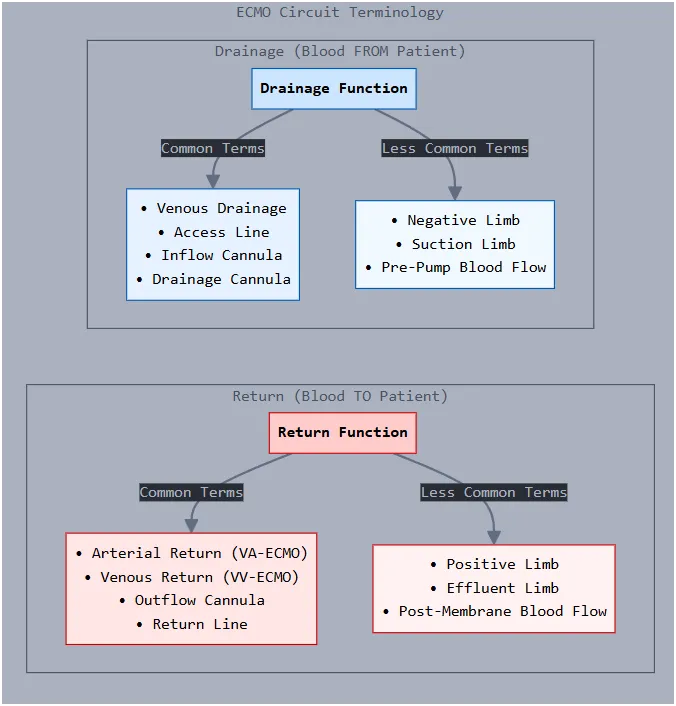
The ECMO circuit consists of two primary functions: drainage and return:
-
Drainage: Deoxygenated blood is withdrawn from the patient into the ECMO circuit, usually via a venous cannula.
-
Return: Oxygenated blood is delivered back to the patient, either through a vein (VV-ECMO) or an artery (VA-ECMO).
Many different names exist for these functions, so I compiled a chart to clarify the most commonly used terminology alongside less common alternatives.
Why Does This Matter?
Clear communication is critical in ECMO management. If different team members use different terminology, this can lead to misunderstandings during patient handoff, troubleshooting, and emergencies.
-
The most commonly used terms align with ELSO guidelines and ECMO specialist training manuals.
-
The less common terms may still be used in certain ECMO centers, among perfusionists, or in specialized discussions.
If you work in an ECMO center where alternative terms are used, it’s worth clarifying and ensuring everyone on the team understands the same terminology.
Whether new to ECMO or a seasoned specialist, understanding and using standardized terms improves communication, reduces errors, and enhances patient safety. If different team members use varied terminology, it can lead to misunderstandings during handoff, troubleshooting, and emergencies.
Have you encountered variations in ECMO terminology during a shift? Do you use any of the less common terms in your practice? Could you share your experiences in the comments? Standardizing our language strengthens team communication and patient care.
Other Links:
https://bit.ly/ecmo143-newsletter
https://bit.ly/ecmo143-youtube
https://bit.ly/ecmo143-company
Acknowledgments:
Here is a list of tools and resources that assisted in creating this article and others. I developed three custom GPTs for specialized research:
-
OpenEvidence (Daniel Nadler and Zachary Ziegler, OpenEvidence)
-
GPT-4o/o1, Claude 3.7 Sonnet/Opus, Perplexity, Gemini 2.0 Flash
-
Grammarly for editorial and proofreading assistance (can’t live without it)
-
Leonardo AI, DALL-E3 AI Image Generator, Microsoft Designer, and Adobe Express for generating images and visual content
Note: This article is intended for educational purposes only. It should not be used as a substitute for professional medical advice or guidance. Always consult with qualified healthcare professionals for clinical decisions and patient care.